
Website Scraping vs Website Crawling: What's the Difference?
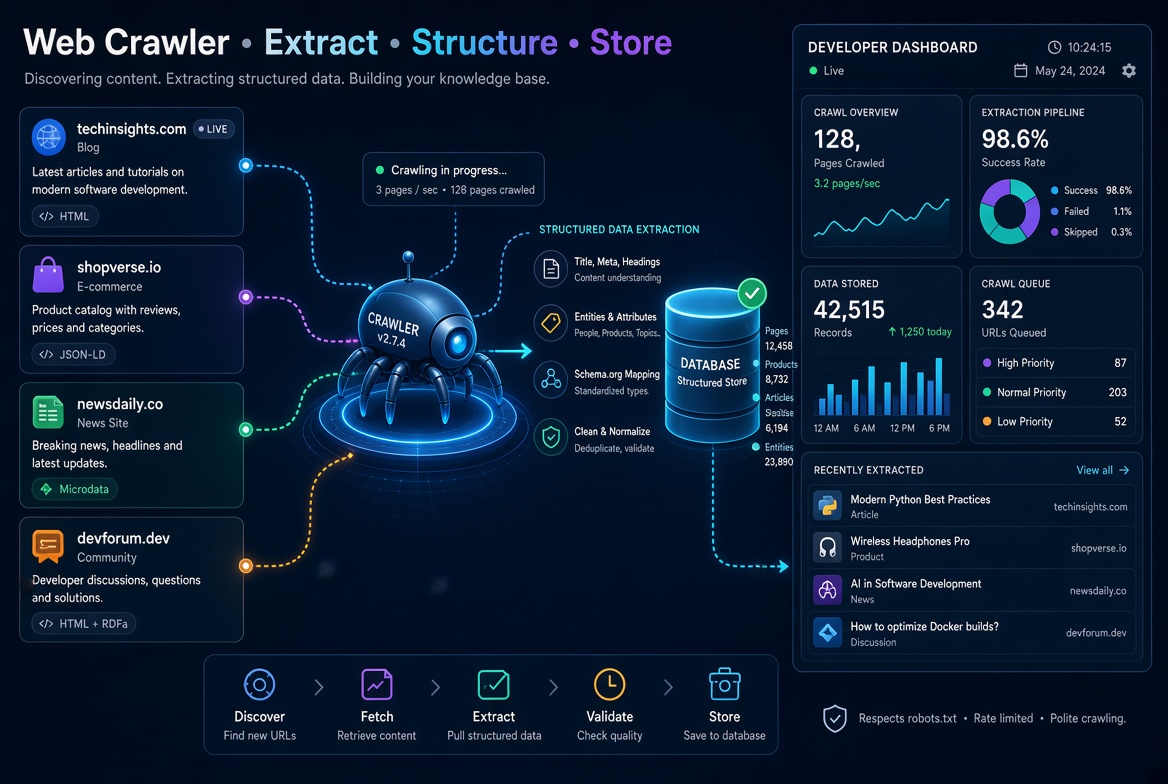
Website Scraping vs Website Crawling: What's the Difference?
The terms web scraping and web crawling are often used interchangeably.
However, they are not exactly the same.
Both involve automated interaction with websites, but their goals are different.
What Is Web Crawling?
Web crawling is primarily about discovering and visiting pages.
A crawler starts with one or more URLs and follows links to discover additional pages.
For example:
A crawler starts at:
example.com
It discovers:
example.com/products
Then:
example.com/products/phones
Then:
example.com/products/phones/model-x
The process can continue across thousands or millions of pages.
Search engines use crawlers to discover and update web pages.
What Is Web Scraping?
Web scraping focuses on extracting specific information from web pages.
For example, a developer might want to collect:
Product names
Prices
Product descriptions
Categories
Images
Article titles
Contact information
Publicly available data
Instead of simply discovering pages, the scraper extracts useful information from them.
The Simple Difference
Think about it this way:
Crawling = finding pages.
Scraping = extracting information.
A system can also combine both.
For example, an e-commerce scraper might crawl product categories and then scrape product information from every discovered product page.
Why Developers Use Scraping
Web scraping can be useful for legitimate purposes such as:
Data research
Market analysis
Price monitoring
Content migration
Internal data collection
Competitive research
Testing
Dataset creation
However, developers should always respect applicable laws, website terms, privacy requirements, and technical restrictions.
What Makes a Good Scraping System?
A reliable scraper should handle real-world websites.
Websites change constantly.
A scraper should therefore be prepared for:
Missing elements
Different HTML structures
Pagination
Dynamic content
Slow servers
Temporary failures
Duplicate products
Empty fields
HTTP errors
A robust system shouldn't assume every website has the same structure.
Category-Based Product Extraction
For e-commerce websites, one useful approach is category-based extraction.
For example, a website might contain:
Phones — 500 products
Laptops — 300 products
Accessories — 750 products
Instead of downloading everything, users could select a category and specify how many products they need.
This makes data collection more controlled and reduces unnecessary processing.
Responsible Scraping
Scraping should be performed responsibly.
Developers should consider:
Website terms
Robots.txt where applicable
Rate limits
Server load
Privacy
Copyright
Authentication requirements
Applicable laws
A technically possible action isn't automatically an appropriate one.
Final Thoughts
Web crawling and web scraping are powerful technologies, but understanding their difference is important.
Crawling discovers. Scraping extracts.
When combined with good engineering practices, they can help developers automate repetitive data-collection tasks and build useful research tools.
The terms web scraping and web crawling are often used interchangeably.
However, they are not exactly the same.
Both involve automated interaction with websites, but their goals are different.
What Is Web Crawling?
Web crawling is primarily about discovering and visiting pages.
A crawler starts with one or more URLs and follows links to discover additional pages.
For example:
A crawler starts at:
example.com
It discovers:
example.com/products
Then:
example.com/products/phones
Then:
example.com/products/phones/model-x
The process can continue across thousands or millions of pages.
Search engines use crawlers to discover and update web pages.
What Is Web Scraping?
Web scraping focuses on extracting specific information from web pages.
For example, a developer might want to collect:
Product names
Prices
Product descriptions
Categories
Images
Article titles
Contact information
Publicly available data
Instead of simply discovering pages, the scraper extracts useful information from them.
The Simple Difference
Think about it this way:
Crawling = finding pages.
Scraping = extracting information.
A system can also combine both.
For example, an e-commerce scraper might crawl product categories and then scrape product information from every discovered product page.
Why Developers Use Scraping
Web scraping can be useful for legitimate purposes such as:
Data research
Market analysis
Price monitoring
Content migration
Internal data collection
Competitive research
Testing
Dataset creation
However, developers should always respect applicable laws, website terms, privacy requirements, and technical restrictions.
What Makes a Good Scraping System?
A reliable scraper should handle real-world websites.
Websites change constantly.
A scraper should therefore be prepared for:
Missing elements
Different HTML structures
Pagination
Dynamic content
Slow servers
Temporary failures
Duplicate products
Empty fields
HTTP errors
A robust system shouldn't assume every website has the same structure.
Category-Based Product Extraction
For e-commerce websites, one useful approach is category-based extraction.
For example, a website might contain:
Phones — 500 products
Laptops — 300 products
Accessories — 750 products
Instead of downloading everything, users could select a category and specify how many products they need.
This makes data collection more controlled and reduces unnecessary processing.
Responsible Scraping
Scraping should be performed responsibly.
Developers should consider:
Website terms
Robots.txt where applicable
Rate limits
Server load
Privacy
Copyright
Authentication requirements
Applicable laws
A technically possible action isn't automatically an appropriate one.
Final Thoughts
Web crawling and web scraping are powerful technologies, but understanding their difference is important.
Crawling discovers. Scraping extracts.
When combined with good engineering practices, they can help developers automate repetitive data-collection tasks and build useful research tools.